2.2.1. Storying the scientists
While STEM scholars debate the centrality and the risks of storytelling and narrative in scientific research, Knight (2003, p. 377) subtly shifts focus by arguing, “Scientific papers tell stories about experiments and data, not scientists.” STS scholars therefore aim to tell stories about scientists and the material assemblages that constitute their production of science. And as Davies (2022, p. 307) writes, this position borders on anti-referentialist, and consequently often draws sidelong glances from STEM scholars:
“There is not only no distinction between ‘correct’ and ‘incorrect’ scientific facts, but between the social (people, institutions) and the technical (objects, experiments). Scholarship in [STS] understands these things as inseparably intertwined, such that it is impossible to claim that ‘social factors’ cause certain forms of knowledge while a ‘scientific method’ or ‘data’ cause others”
One of the more influential books in STS—one that caught the most attention in terms of the co-constructed and discursive nature of science production—is Laboratory Life (Latour & Woolgar, 1986 [1978]). In Laboratory Life, the authors follow a biology lab and lay the foundation to argue three key points: (1) science is a co-constructed, inscriptional process of establishing a fact. In fact, “The function of literary inscription is the successful persuasion of readers” (Latour & Woolgar, 1986, p. 76, emphasis added). (2) Science constitutes a material erasure of the science that came before it (i.e. the tools, theories, or apparatuses that contribute to present-day experiments). In other words, “The apparatus and craft skills present in one field thus embody the end results of debate or controversy in some other field and make these results available within the walls of the laboratory” (Latour & Woolgar, 1986, p. 66). (3) Scientists’ activities are constrained by an economy of credit and credibility. Therefore, “scientists’ behavior is remarkably similar to that of an investor of capital. An accumulation of credibility is prerequisite to investment” (Latour & Woolgar, 1986, p. 197). In short, Latour and Woolgar do not explicitly discuss their ethnographic observations in terms of story or narrative, yet they emphasize scientific production as driven by (1) literary inscription (emphasis added), (2) co-construction of facts by assemblages of human actors and non-human actors (e.g. tools, instruments, machinery), and (3) salesperson-like economies. These three observations parallel storytelling trajectories (Morange, 2022; Millerand et al., 2012; ElShafie, 2018). Latour & Woolgar themselves even playfully position themselves as storytellers throughout the text. “In a fundamental sense, [their] own account is no more than fiction” (Latour & Woolgar, 1986, p. 257).
In a follow-up monograph, Latour (1987) expands on his previous descriptions of co-constructed, narrative-driven systems of academic publication and citation, pointing to the establishment of facts as dependent on scientists’ sedimented ratification or challenge of inscriptions within a layering of publications and scientific artifacts (e.g. conference proceedings, symposia). Latour thereby describes the academic publishing landscape as a dance between fact and controversy, where facts are often presented as bare, uncited assertions, and where controversy invites more technical language, more jargon, and more references (and the subsequent unpacking of those references) in an entropic process of scientific discourse deconstruction. Latour iconizes these tensions in terms of scientific discovery and production through a series of Janus-faced cartoons – two-sided figures that represent Ready Made Science on the left side and Science in the Making on the right side (p. 4). I reproduce one example in Figure 1 below, as it speaks directly to the tensions outlined among STEM researchers.
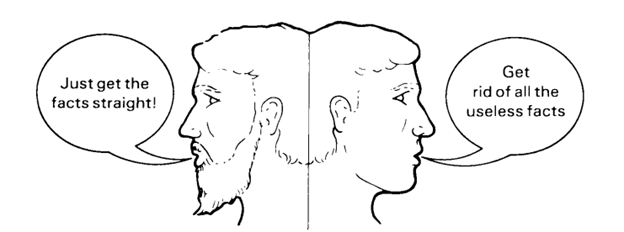
Figure 1. Janus-faced cartoon representing the tension of “facts” in scientific production (Latour, 1987, p. 8).
Latour recasts scientific publication from the dry presentation of information to a drama of citation, counter-citation, and the unraveling of facts by readers and writers. And as Figure 1 demonstrates, left-side Janus represents a realist account of science while right-side Janus represents a narrativized constructivist account of science (more on this below). Within this binary, Katz cites Latour (1987) while arguing against storytelling practices in the (re)presentation of scientific results.
Dissecting the structure of scientific papers, Bruno Latour explains the utility of the storytelling approach in giving readers the sense that they are evaluating the data along with the authors while simultaneously persuading them of the story. The storytelling way to achieve this is “to lay out the text so that wherever the reader is there is only one way to go [Latour, 1987, p. 57]” (Katz, 2013, p. 1045).
This marks a key divergence between STEM and STS researchers. While STEM researchers seem most concerned by adhering to scientific modes of inquiry – modes that promote multivocality and precision and avoid misleading singular narratives, STS takes an outsider view, showing how the distributed cognition and actions of scientists and their material ecologies constitute stories in practice and in product. Katz also signals the skepticism many STEM researchers hold towards STS. Many scientists assume that “outsiders’ interests must focus on the seedier aspects of scientific life because investigators are seen to be posing questions which are essentially irrelevant to practical scientific activity” (Latour & Woolgar, 1986, p. 19). This strikingly aligns with STEM scholars’ similar skepticism toward science journalists – those who, in other words, chase stories above science (National Academy of Sciences, 2017; McComas & Shannon, 1999; Sumner et al., 2014).
Ironically, this also means most scientists are concerned more with the productivity and creativity of science rather than the substance of scientific thought and scientific work (Latour & Woolgar, 1986, p. 11). “Scientists, [therefore], are not drawn to read what outsiders have to say about science and much prefer the views of scientists about scientific endeavors” (ibid.). Analysis of the literature thus far suggests that storytelling fits within this purview of non-scientific, “seedy” endeavors – support for Bruner’s (1986) distinction between paradigmatic modes of thought (preferred by STEM) and narrative modes of thought (accepted by STS).
Ontogenetic Reflection
Although I only wrote this five months ago, the grind of graduate school and the intellectual growth that I’ve been experiencing in the past six months really helps me recontextualize this section as a realization of a plane of consistency. What I mean by a plane of consistency is that, in opposition to Deleuze’s plane of immanence, I wrote this section not from a plane of infinite potentiality, but of an incipient plane of sense-making. This sense-making came from my early readings from key (though laughably inexhaustive) figures in science and technology studies like Davies, Law, and Hacking, as well as Latour (1987) and Latour and Woolgar (1978).
It’s not that I see what I wrote as wrong or cringey, but rather that it was operating from a place of excitement that exceeded my understanding, yet also pulled my understanding forward in excess of what I could realistically articulate on this topic in less than a thousand words. I would, in other words, consider myself a novice reader in the field of science and technology studies, yet sometimes — sometimes I think following curiosity to make a point of entry into a conversation can be very generative. Even if it is not the path, it can become a path in service of building towards a greater insight — a movement diffracted through the constant collisions of concepts, theories, and ideas. It reminds me of the first three lines of a poem that I encountered scribbled on the inside cover of an English translation of the Zhuangzi:
“Anyone who excites you should be told so, and loved if you can.”
Here I can see the excitement exceeding the love, which I suppose is very much a condition of comprehensive exams. In my department, we aim — unlike what the title of the test would suggest — not to prove a comprehensive regurgitation of our knowledge, but rather our ability to form critical arguments around the knowledge that we are able to engage with. I don’t say literature, because I think that the knowledge that we can engage with that can be metabolized into scholarship far exceeds that which is in published journal articles. The idea that we hold such published articles or books at the top of an apparatus of credibility is very much part of the notion of colonialingualism that I see as so prevalent and trendy in discussions within the field.


Leave a Reply