I encountered Pratt (2008) while reading Nguyen and Makoni’s (2026) critical analysis of cosmopolitanisms among migrant Australian residents. Within their methodology, Nguyen and Makoni invoke Pratt’s concept of “power quotes.” Power quotes are the illustrative quotes that many qualitative researchers in applied linguistics use when trying to find the best stories that exemplify the themes illuminated within the paper. Many mini power quotes appear in paper titles as well. But what really drew me to read this article for myself was (1) Pratt comes from an organizational background similar to David Boje and antenarrative, and (2) Pratt provides illuminating insight on the tensions latent within reflexive thematic analysis (Yessenbekova & Hajar, 2026) and the quantitative and positivist frames that often place qualitative inquiry under attack.
I find that the use of theme counts often triggers more positivistic frames by reviewers. However, if one’s goal is to look more like a round peg, then this tactic would be consistent with that aim. Finally, this approach literally hides the voice of the informant—a voice that many qualitative researchers want to capture. One needs to ask, “Does an article’s thematic categories mirror the language used by its sample?” Without some data, it is impossible to tell. (Pratt, 2008, p. 500).
As an applied linguist who dabbles in organization studies, I was struck by how Pratt advocates for the use of direct quotes of participants from interview data. This receives major attention throughout the paper’s implications section. I am an applied linguist who often conducts qualitative studies centered around participant excerpts — a scholar who centers language in production and its co-construction. I therefore found it alarming that an influential qualitative methodologist within business studies advocates for a practice that I find to be mundane. Including the words or creations of participants in qualitative analysis is methodological table stakes.
What is meaningful, however, is the way theme counts trigger positivistic frames by reviewers. This is an intriguing causal argument. Though, donning my positivist noodle cap, I also notice Pratt does not provide any experimental data to back up this claim. It reminds me of the continuous lamentations of Braun and Clarke — that people use and abuse their conceptualization of reflexive thematic analysis (2006) by adopting positivistic criteria of generalizability, theoretical saturation, inter-rater reliability, or other positivistic frames.
Yet I also wonder if such positivistic frames require triggering in applied linguistics. From my standpoint, they are everpresent. Applied linguistics engages in constant tension between its positivistic, scientific, evidence-based pole and its interpretive, social-theoretical, post-positivist qualitative pole. The social scientist seeking evidence-based approaches to second language education meets the humanities thinker seeking to deconstruct and reconstruct conceptualizations of language through critical lenses. And all of them meet education scholars equally polarized by evidence-based interventions prioritized by funding bodies and counterbalancing post-foundational theorization about the nature of education. However, to argue that qualitative and quantitative researchers exist in a box would deny the near ubiquity of positivistic frames adopted by many reviewers who ask for a codebook or more transparency regarding how researchers generate themes from codes. Braun and Clarke therefore stress the importance of a reflexivity log to make researchers’ analytical processes transparent.
Were it only so easy to be transparent and to document a systematic approach. If I could summarize misuse of Braun and Clarke in one sentence, it would be the rigid over-systemization of methods intended to be flexible, interpretive, and story-based – guidelines as a starting point rather than a map. The question is: when a reviewer criticizes the “rigor” of our methods, do we play the game, or do we stick to our guns? A non-rigorous survey of my LinkedIn feed suggests this to be an ongoing critical question. We can see a hierarchy of positivism subordinating interpretivism or constructivism. Yet how can interpretivists and the constructivists talk back to the positivists?
Pratt suggests that positivist performance like counting themes or sharing percentages can sometimes help to “look more like a round (positivist) peg” and thereby pay price of admission in to play the academic publishing game. But I would argue that, in line with Angus Fletcher’s storythinking, that the goal is not to accept positivist frames. After all, why would a positivism-inclined reviewer stop at counting themes? To adopt a positivist frame is to push further down the positivistic path. Once we count themes, they will ask for inter-rater reliability measures or statistical power measures of sampling to make sure that the counts are “accurate” or “significant.” Big-Q qualitative research shares a story. A small-q researcher asks, “but how do I know it’s the true story?” According to Fletcher, to sink into positivist frames is to erase the most compelling parts of storythinking – namely emphasizing movement over propositional links, and thinking otherwise over proving something true.
No. It pays to lean the other way — to tell a compelling story; to wrest positivism’s control over the faculties of researchers caught between the pull of two poles. Because those between the poles have enough space to negotiate movement between poles. I would not send a narrative analysis to a chemist and expect a warm methodological reception. For most, disciplines like the natural sciences are too steeped in positivist theory and rhetoric. But most qualitative researchers in applied linguistics do not sit at the far end of the quant or the qual pole. Rather, we are all somewhere in the middle, and people in the middle can be pushed much more easily than those who hug the walls. By “push,” I mean persuade. Such dialogues between reviewer and writer need not be coercive but they are irreducibly co-constitutive.
However, once I get past Pratt’s advocacy for including emic language data within research reports, the question of writing comes to the fore. Many justice-minded qualitative researchers hope for participants to speak for themselves. It is an admirable goal to resolve power differences rendered through the researcher’s pen; to elide the researcher’s voice in favor of participants’ verbatim understandings, arranging excerpts to resemble an unnarrated documentary. But we also know that the conventions of academic publishing require more than participants’ voices. The analyst is more than a curator and collage artist of participants’ thoughts. Researchers themselves bring an interpretive lens – even the lens that decides what to include, what to exclude, and the order in which excerpts are arranged. This already reflects the epistemological commitments of the researcher. Unless the researcher wishes to abdicate their working responsibilities to participants, then the analyst will play a vital role in the preparation and publication of research reports.
This includes writing, and specifically how to stage movements of resolution by writing. Karimzad and Catedral (2021) discuss resolution in relation to chronotopes — an analyst can speak to phenomenon at diversifying scales in order to render a layered story of ethnographic data, moving from hyper-local situated interactions into theorizations of global-level systems and interconnections. The analyst therefore selects a power level for their literary microscope at the level of section, paragraph, and sentence.
This forks the issue of transparency, a buzzword in discussion of reflexivity in applied linguistics, into two distinct senses. Transparency can imply (1) a clear looking-glass view that demonstrates systematicity and rigor through patterns of documentation that show that findings reflect a phenomenon that holds up independent of the analyst’s subjectivity. This is a positivist frame of transparency. Transparency is also (2) about explicitly narrating analytical moves, regardless of whether those analytical moves hold up to deductive, inductive, or other forms of positivist reasoning. This is a reflexive frame of transparency. These two forms of transparency are similar, but not equivalent.
This separation of transparencies shows where resolution and transparency go hand-in-hand, as Pratt’s diagram demonstrates.
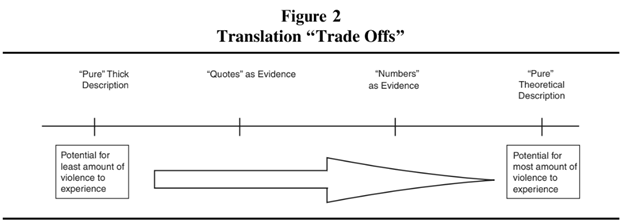
Qualitative research aims to articulate and represent the complex, lived, sensemaking experience of intersectionally situated participants. This chart reminds us that as we write, we as authors take multiple stances and points of view toward our participants, our participants’ words, and our participants’ stories. I appreciate the fact that Pratt presents this as a horizontal line. Rather than letting participants “speak for themselves,” it is essential for an analyst to contextualize participants’ stories for a wider academic audience. This includes readers steeped in literature and theory that participants may not (1) be aware of nor (2) care to learn about. Although theory often aims to explain phenomena, such explanations may not be practical even if they are convincing. Therefore, there is no gold standard to suggest favoring one resolution or to include all resolutions equally. For any published qualitative study worth its salt – salt accumulated through the blood, sweat and tears of authors, editors, and reviewers — a compelling qualitative research report will oscillate between multiple resolutions. This not only makes a study meaningful, but also gives it a compelling rhythm – a movement through time, space, and scale that gives readers a sense of surprise in an otherwise transparent rhetorical field.
Eric Hayot, author of The Elements of Academic Style, talks about this movement through visual metaphor — the “inverted U.” This is a writer’s guide to stylistically implementing Pratt’s suggested cline of resolution. Ranking sentences along a continuum similar to Pratt, with (1) representing direct evidence or data, and (5) representing theoretical, conceptual, or overarching claims. Effective paragraphs are not held to one type of sentence but move down into evidence that grounds the paragraph and up towards theoretical upshots. These are movements a scholar must master to make their work not just intelligible, but compelling and sticky to an academic audience.
What I found most striking in Pratt’s article, however, was his use of the word “violence.” This is a concept that burrowed into my head a while ago — epistemic violence. I encountered the concept in Dr. Sinfree Makoni’s class on the decolonial sociopolitics of language, as well as the Africana Studies Global Virtual Forum. I understand Epistemic violence in relation to Global North scholars exporting theories to investigate raw data in Global South contexts. This asymmetry recontextualizes, distorts, and erases Indigenous epistemic structures within Global South communities. Epistemic violence labels other epistemological paradigms as as deficient, mutilates and erases such paradigms, and supplants them with Global North, Western ways of knowing. This is one facet of the Western colonial project.
I therefore grew skeptical of reading applied linguistics papers, particularly ones that simultaneously adopt narrative inquiry and thematic analysis as methods. Such studies tend to chop up interview data as if they were survey data, stick them into bins called “themes,” and then lift interview utterances from their situated interview context into the epistemic regime of themes. This rearrangement tells a new story that accords with storylines generated across cases. This search for shared patterns of meaning often erases the tensions, contradictions, and inconsistency of themes when applied to single stories. I used to call this practice “mundane and violent”; mundane because it was extremely common; violent because it extracts abstracted data from the embodied and situated nature of participant storytelling. This extraction sanitizes stories of dirt, grime, and mess, to present it as clean, logical, scientized academic discourse.
I no longer think about thematic analysis in such hyperbolic or reductive terms. Reading Braun and Clarke closely reveals their two-decades-long struggle against misinterpretations of their approach to thematic analysis, including (1) observing that many people cite but fewer people actually read their publications, and (2) recognizing that thematic analysis need not always ignore the situated context of an utterance’s production and need not render a research report in a form of epistemic violence.
But this does draw us back to transparency. Pratt advocates for qualitative analyses that more closely resemble interview data as a situated encounter. To provide a faithfully rendered transcript is to align more closely with a positivist frame of transparency: a transcript that maintains greater linguistic and paralinguistic detail — particularly when such excerpts can also include preceding interviewer input to better contextualize a participant’s situated utterance. But to move up beyond this level (transcription is, after all, not a neutral choice), then we also move away from a direct encounter with (a simulation of) participants’ voices into a direct encounter with the theoretical voice of the analyst. Pratt labels this as “violence.” I now see that melodramatic. I no not see inherent violent when an analyst interprets a participant’s story if they reflexively frame an interpretation as theirs, rather than an interpretation that is “true” or “comprehensive.” After all, if an analyst need not interpret, why get a PhD? (Don’t answer that.)
However, an analyst can reduce the risk of overinterpretive violence by (1), consulting with participants when possible and (2) grounding arguments within other scholars in the literature, connecting them with participants’ own verbal, visual, or artistic creations. This makes analysts’ interpretations – their sensemaking leaps – connective rather than novel. Reviewers find the novel in the connections. To bring unexpected scholars to the party and surprise a reader with their ensuing chatter. What do your participants contribute to sensemaking within the literature? What does the literature contribute to the sensemaking your participants’ story? And where do you, as the researcher, position yourself as sensemaking mediator?
It is easy to see this reframing of analyst-as-connector as a call for generalizability. To connect a participant’s story to stories in the academic literature renders a story more generalizable. This is a hasty conclusion, as Pratt’s classroom anecdote suggests:
A student in my qualitative research methods class, John Burke, summed up this type of generalizability with a Chinese proverb: “A sparrow is small, but it has all the organs.” Thus, one can argue that an in-depth study of any organization can lead to insights into other organizations because at some level” they all have the same organs (Pratt, 2008, p. 496).
While I am unfamiliar with this Chinese proverb, I appreciate the license to talk about Daoism – something I do not often see in qualitative research circles. Specifically, I recall a very famous quote from Zhuangzi.
For to be a ‘this’ is in fact also to be a ‘that,’ and every ‘that’ is also a ‘this.’ ‘THAT’ is then itself already both ‘this’ and ‘not-this,’ both a right and a wrong. But ‘THIS’ is also itself already both ‘this’ and ‘not-this,’ both a right and a wrong (Ziporyn, 2020).
When I read this quote next to Pratt, I see Pratt employing an anecdote to help us think beyond purely structural or statistical definitions of generalizability in research; to apply research through structural analogy. Yet when I engage with Chinese philosophy, I challenge the assumption of separate of entities between which structural analogies are drawn. It ignores how the understanding of one thing is inextricably relational. A sparrow is small but has all the organs, but only by looking at other birds can one even begin to specify which organs are bird organs. To understand a bird is to also understand a not-bird.
But once we start thinking about organs, Mazzei (2016) arises to give me a post-qualitative lecture on the voice without organs. Drawn from Deleuze and Guattari, new materialist thinkers often employ the analogy of the body without organs to conceptualize a discursive and social construction the human, the individual, the body greater than the sum of its parts. This humanist gestalt centers an often unstated but critical epistemological assumption that privileges the point of view of the human and the human point of view as a monolith. For this reason, Mazzei (2016) considers inquiry not as an organization of separate bodies, but as a researcher-data-participants-theory-analysis assemblage.
Put otherwise, many scholars theorize interview data not as one participant’s clear articulation of their lived experience, but rather as a situated, meaning-making assemblage that consists not only of the interviewer and their epistemological assumptions (i.e. the identities they carry and the questions they ask or the responses they attend to). It also includes the interview genre as an assemblage – a site of becoming where participants and researchers bring overlapping but distinct genre expectations. The assemblage is also material. Interviews conducted on Zoom have different contingencies than interviews conducted in-person. Lord knows, talking to my mother on Zoom affects me very differently than a face-to-face chat in the living room.
So, while I take Pratt’s point that structural analogies or differences of scale can amplify the “generalizability” of a qualitative study, I was struck by the invocation of a Chinese proverb because my own foray into ancient Chinese philosophy is more skeptical of the separateness of people and objects and bodies in the world. And if these bodies are not definitively separate, then one cannot draw structural analogies between them. How can we draw an analogy within a continuous state of inter-being?
And to interpret the use of organs in light of the voice without organs, we can also see how generalizability runs afoul of the epistemological assumptions that create the unquestioned frame of objectivity without interrogating the social constructions of the criteria that establish such inductive or deductive objectivity. Such assumptions are not only limited to knowledge and knowledge-making but are also intimately entangled with the stylistic assumptions within research reports.
I am not attracted to Daoism because it gives me clear, transparent answers about how to approach research writing. As the first line of the Daodejing famously says — 道可道,非常道;名可名,非常名 — “the dao that can be told is not the eternal dao; the name that can be named is not the eternal name.” It puts researchers in precarious positions, trying to name a world that ultimately resists ultimate knowability and nameability. Or, as analyses of Zhuangzi suggests, language ultimately demarcates perspective and produces small completions or closures upon a full contemplation and appreciation of multiplicitous worlds (Ziporyn, 2020). In this way, academic writing becomes a tragedy. Writing in a linear pattern across a fixed page is a requirement for any academic to find traction in the community, but it also fixes, closes off, and erases alternative possibilities of meaning-making — including the possibility that the separateness of entities is itself an epistemological assumption. One such site of closure is the IMRAD template that dominates both quantitative and qualitative research reports. While some academics argue for a homogenizing style to illuminate differences in ideas, the style to which one homogenizes is never neutral.
Although having agreed-upon templates may make it easier to fit a qualitative study into a journal-length format, it is not clear that one template will work for the various types of qualitative methods. Thus, I suggest managing this tension through the creation of checklists rather than through templates. Checklists point out what elements need to be a part of a Method section without prescribing the order of or the form for how these elements are to be addressed. But what should such a checklist include? (Pratt, 2008, p. 502).
Braun and Clarke (2006, 2025) do include such checklists. However, the problem of creating a shared standard of rigor, quality, or other noun du jour of qualitative research is that qualitative researchers each carry distinct methodological fingerprints. A researcher’s inability to include all elements of a checklist, in other words, does not necessarily mean an approach lacks methodological coherence.
I thought about this while reading Monroe’s (2018) argument against mandatory open data sharing in qualitative research. Qualitative research ethics extend down to micro-level, participant-specific contingencies. Ethics, and therefore data privacy, cannot be standardized into any kind of open data sharing platform. Monroe, for instance, talks about interviewing Syrian refugees, Holocaust survivors, and many other vulnerable populations with politically sensitive stories. She talks about how some participants preferred to provide background but not go on record; some wanted their stories to be summarized rather than presented verbatim. To bring a checklist to anomalous assemblages of data and the human relationships that data indexes ignores how relationships are not standardizable. Qualitative research is more phronetic than procedural. Braun and Clark, however, do provide a values-based framework for evaluating the quality of a reflexive thematic analytical paper. But it struggles with the same problems of their 2006 paper, namely trying to reconcile story thinking and logical thinking; trying to tell a story and maintain flexibility and creativity while also subjecting studies to shared standards of rigor.
That does not mean that I will give up my quest to improve methodological reflexivity and creativity in qualitative research, but it does mean that I do not think a standard or a framework might be adequate. Or we must acknowledge that every framework has exceptions. And as those exceptions pile up, we need to question and revise constructs within the framework. Qualitative research is not a prescriptive, systematic audit trail. It is a living, breathing method of inquiry that simultaneously wants to collapse itself onto a shared solid center while also resisting the power-laden hierarchical pull of such gravitational, centripetal collapse.
Reading Pratt (2008), I learned about more than just power quotes. I learned that doing qualitative research requires me to stand behind my perspective (Braun & Clark, 2006). And standing behind my perspective means going beyond academic publishing to develop my own out-of-literature reflexive sensemaking project. This is one step in that direction, and I am excited for many more.
References:
Braun, V., & Clarke, V. (2006). Using thematic analysis in psychology. Qualitative Research in Psychology, 3(2), 77–101.
Braun, V., & Clarke, V. (2025). Reporting guidelines for qualitative research: A values-based approach. Qualitative Research in Psychology. https://doi.org/10.1080/14780887.2024.2382244
Feng, G., & English, J. (Trans.). (1972). Lao Tsu: Tao Te Ching. Vintage Books.
Fletcher, A. (2023). Storythinking: The new science of narrative intelligence. Columbia University Press.
Hayot, E. (2014). The elements of academic style: Writing for the humanities. Columbia University Press.
Karimzad, F., & Catedral, L. (2021). Chronotopes and migration: Language, imagination, and social behavior. Routledge.
Mazzei, L.A. (2016). Voice without a subject. Cultural Studies↔Critical Methodologies, 16(2), 151–161.
Monroe, K. R. (2018). The rush to transparency: DA-RT and the potential dangers for qualitative research. Perspectives on Politics, 16(1), 141–148. https://doi.org/10.1017/S153759271700336X
Nguyen, T.T.T., & Makoni, S. (2026). On Northern, Southern, and entangled cosmopolitanism: English language ideologies among migrants in Australia. Critical Inquiry in Language Studies, 1-28.
Pratt, M. G. (2008). Fitting oval pegs into round holes: Tensions in evaluating and publishing qualitative research in top-tier North American journals. Organizational Research Methods, 11(3), 481–509.
Yessenbekova, K., & Hajar, A. (2026). Two decades of research on Braun and Clarke’s thematic analysis: a bibliometric mapping and research agenda. Qualitative Research in Psychology, 1-37.
Ziporyn, B. (Trans.). (2020). Zhuangzi: The complete writings. Hackett Publishing.


Leave a Reply