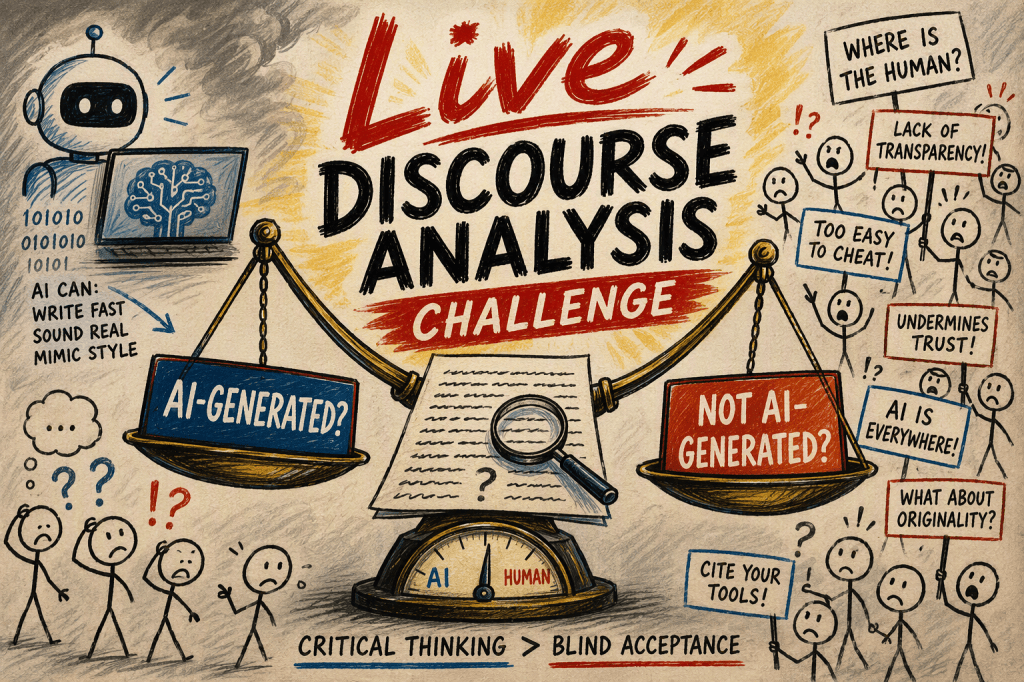
Image generated via Microsoft Copilot.
I scroll through my LinkedIn feed longer than I should. It is one of those days where my perception of the speed of life paralyzes me into anxious inaction. On my feed, every other post I see a scholar or teacher ranting about (1) a paper they peer reviewed that appears to be AI-generated, (2) student essays that appear to be AI generated, or (3) emails they received from students or colleagues that appear to be AI-generated. My problem is not with how they feel. We all feel as we feel, and sometimes I feel frustrated with that uncanny, shiny, surfaceless prose that feels machine-generated. What frustrates me today, however, is how “written by AI” stands in as a self-evident condemnation of writing and, by extension, a writer. I find too often that people finish their arguments at “this text seems to be AI-generated,” leaving implicit arguments against the writer as someone lazy, deceitful, or worse.
I can see why so many scholars feel this way. As professionals who depend on reading, writing and idea generation for our work, it is deeply unsettling to question the existence of a person behind writing. This is an assumption we, until now, have taken for granted. Even plagiarizers, back then, were people exercising the agency to plagiarize. This is no longer the case. However, I am now finished with finishing an argument at “AI-generated” — as if arguing that a text was AI-generated was an argument at all. If we are unhappy with a piece of writing, then whether AI wrote it or not is beside the point. If we see a data analysis as shoddy or shallow, or a literature review as lacking novel contribution, let’s say so.
This is different from the posts and publications keen to statistically and anecdotally discern the features of AI writing. Yet it is also the same argument with a different shape. The logic is thus: if we can create a reliable cluster of linguistic features associated with AI, then we can reliably point out those who rely too much on AI. With these reliable detective skills, we can turn the off the tap and stem the slop. Setting aside the argument that the AI-human generated binary is a false one, and labeling writing as AI-generated is a fool’s errand conditioned by a machine learning feedback look, it is more interesting to ask about the moral significance that we put onto AI usage. Often I see an uncritical assumption behind the “I read an AI-generated message and I’m angry” screed: an uncriticized statement of “AI-generated equals bad, lazy, dishonest, or [insert adjective here] writing and writers” I’m not here to say this reaction is wrong or misguided. Rather, I argue this terminating argument obscures the fear and anger that many of us draw from the rise of generative artificial intelligence.
In some ways that fear is justified. Unless you avoid the news, it is hard to avoid stories predicting the rise of omnipotent autonomous AI agents running societies into either (1) utopia, (2) the ground, or (3) oblivion. It’s very disheartening and disorienting encounter machines that can effortlessly generate text — an act that writers for millennia ascribe to muses, resistance, and the pain of creation. And it’s terrifying to see how rapid investment into AI has put economies onto a precarious, spherical, easily poppable precipice — a collapse that increasing numbers of people predict as inevitable. The more and more people predict a collapse, the more we spiral into a self-fulfilling prophecy of collapse.
I sit here as a fourth-year PhD student, enthralled in the privilege of reading, writing, and thinking, wondering if pursuing academic jobs will be a coherent career path in five to ten years. I’m afraid that AI will make us more efficient, more productive, and busier than ever. We have been poorly predicting the end of work ever since John Maynard Keynes predicted a four-hour work day in the early 20th century. The truth is, we have become exponentially more productive and marginally more busy. I say marginally because the margins have been slim for a long time. And AI only accelerates those exhausted margins to their breaking point.
Oftentimes I read contempt in the voices of those who share their “this is AI-generated” encounter stories. It has become ubiquitous to the point of constituting a genre on social media. Underneath that content, however, I see fear — fear of being dragged into a future that we did not sign up for, fear of being relegated to a dustbin unless we all agree to embrace AI in all aspects of our work life, fear for the oppressed and marginalized being squeezed into margins already nearing exhaustion. As the trope often goes: “AI will not take your job, but someone who uses AI will.” I no longer understand this adage. To me it is the same thing. For what is the difference really between a AI-using human and a human-using AI. Both control the narrative with AI at its center. And with AI at the center, my biggest fear is that soon there will be little hope for people who do not embrace AI and its enshittifying slime trail.
It is time to retake the narrative by re-centering skills AI cannot take from us — our judgement and creativity. I call for practitioners to dispense with the accusation of “AI generated” as if it were a self-evident condemnation. Instead, let us furiously and relentlessly bring human intervention back into our discourse. Any computer can make a binary choice — especially if it is indifferent to the correct choice. Rather, I ask you to get specific. If you are reading a manuscript glossy yet conceptually empty writing style, call it like you see it. If you encounter a video that makes you feel disconnected and disoriented in an uncanny valley, say it so.
To simply declare something as “AI” or “not AI” is to surrender to the same binary logic that computers and its supporting technopoly will snuff out if we do not fight. After all, despite my AI skepticism, I have encountered pieces of AI-generated writing that I found thought-provoking and compelling. When I read Thomas Mabanu’s essay on the use of AI within the economy of scholarly writing and publication, I both had a lingering suspicion of AI reliance (particularly with its repetitive argument structure of “not X, but Y”) Yet by the time I finished the essay, and I read Manabu’s AI disclosure statement, I did not care. Because I liked it; because I could tell that somebody thought about this issue for a long time and put serious effort into constructing a compelling argument. Manabu’s use of AI became irrelevant to me.
So the next time you rant about your encounter with suspected AI generated writing, go deeper, get descriptive, call it like you see it, bring back the nuance of judgment that computers are fatally ill-equipped to handle. After all, to end an argument with “this is AI-generated” sends the wrong message. It counter-incentivizes writers not to improve their thinking or writing voice, but to mask their AI usage. Barring the catastrophe many people predict, GenAI will not disappear. But we can reframe the conversation so its presence or absence becomes irrelevant.


Leave a Reply